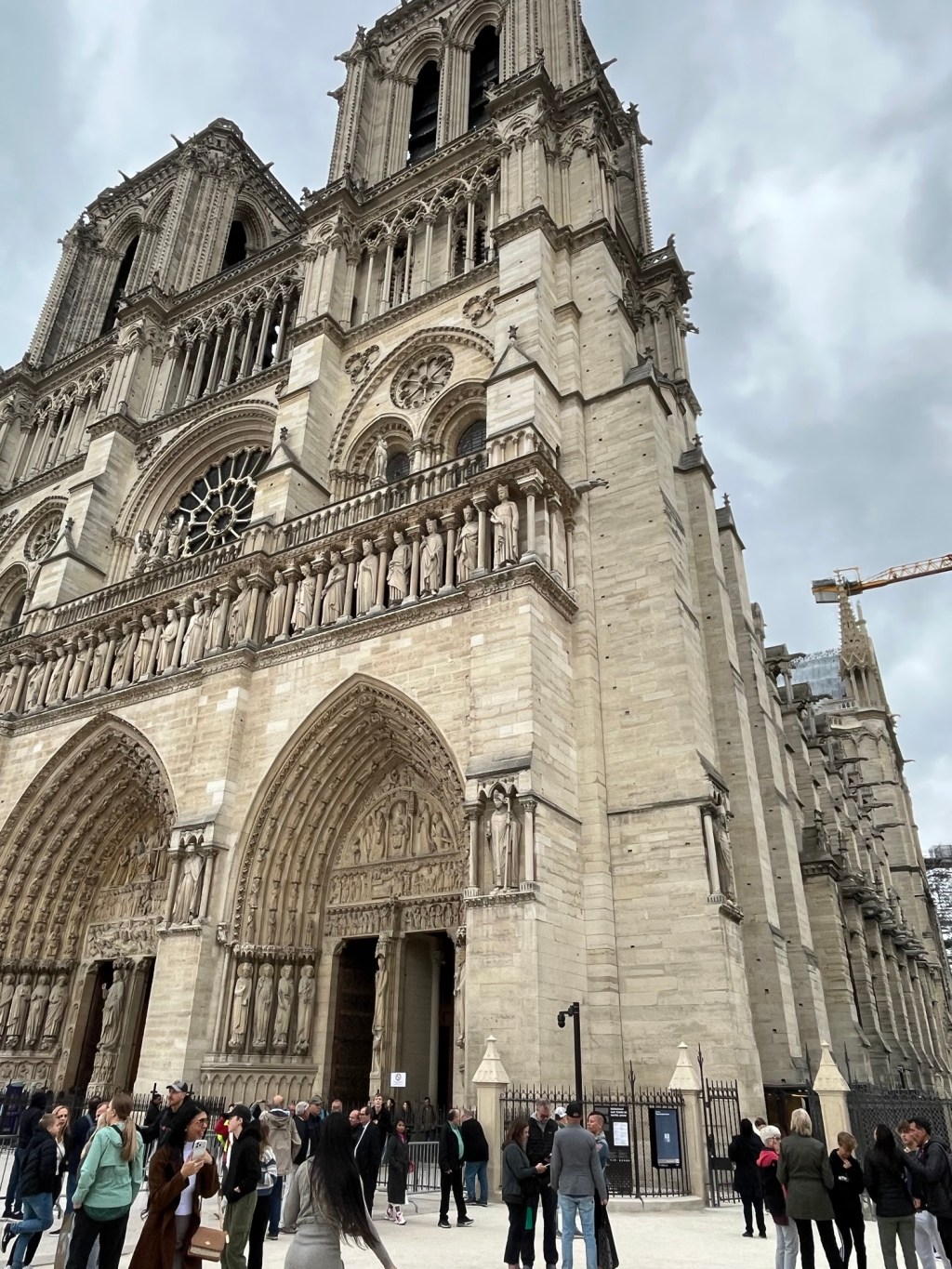
Reading Victor Hugo’s, Notre-Dame de Paris, I came upon this great chapter in book five: “This Will Kill That”. Read this chopped up excerpt from it and see what you think. Has architecture died and been dying since the fifteenth century? Do we still build great beautiful things or do we just write them? And do we write them anymore?
His question paraphrased:
“Does changing the form of human thought change its expression?”
Hugo says: YES !
“With the fifteen century everything changed.
Human thought discovered a means of perpetuating itself not only more durable and more resistant than architecture, but simpler and easier Architecture was dethroned. Orpheus’ letters of stone were succeeded by Gutenberg’s letters of lead.
The book is going to kill the building.
The invention of the printing is the greatest event in history. It is the mother of revolutions. It is humanity’s mode of expression totally renewed, human thought discarding one form and putting on another, it is the complete and definitive change of skins of that symbolic serpent which, ever since Adam has represented intelligence.
In the form of printing, thought is more imperishable than ever; it is volatile, elusive, indestructible. It blends with the air. In the time of architecture it became a mountain and took forceful possession of air and a space. No wit becomes a flock of birds, scatters to the four winds and simultaneously occupies every point of air and space.
…And when you observe that this form of expression is not only the best for conversation, but also the simplest, the most convenient, the most universally available; when you think that it is not encumbered by baggage and requires the moving of no heavy apparatus; when you compare the way thought, before it can be translated into a building, has to set in motion four or five other arts and tons of gold, a whole mountain of stone, a whole forest of timber, a whole people of workmen; when you compare it with a thought becoming a book, needing only a little paper, a little ink, and a pen, how can anyone be surprised if human intelligence has forsaken architecture for printing?
…Look, then, at how since the discovery of printing architecture has gradually dried up, atrophied, and been stripped bare. What a feeling one has of waters falling, sap failing, the thought of ages and peoples withdrawing from it! This cooling-off is almost imperceptible in the fifteenth century, the printing press is as yet too feeble, and at the most daws off from mighty architecture some of its superfluous vigor. But already from the sixteenth century on, architecture’s sickness is evident; it has already ceased to be the essential expression of society; it transforms itself miserable into classical art; once Gaulish, euro[ean, indigenous, it becomes pseudo-antique. This decadence is what is called renaissance. A splendid decadence, though, for the old Gothic genius; the sun setting behind the gigantic printing press at Mainz still for a while sheds its final rays on that hybrid heap of latin arcades and Corinthian colonnades.
This setting sun is what we take for a new dawn.”
Victor Hugo, Notre-Dame de Paris, Book Five, pg 200-201.

 Billy and Bobby Go Abroad
Leave a comment